Let’s talk email disclaimers
Wait, come back, they’re FASCINATING. Also, they’re a GREAT OPPORTUNITY for brands.
We’ve all seen bazillions of them. The chonk of legal blather at the bottom of emails. If we printed them all out, they would make a pile by the office recycling bin that reached halfway to the moon. If we could harness the power of all the scrolling past them we need to do in email chains, we’d create enough kinetic energy to power Belgium.1
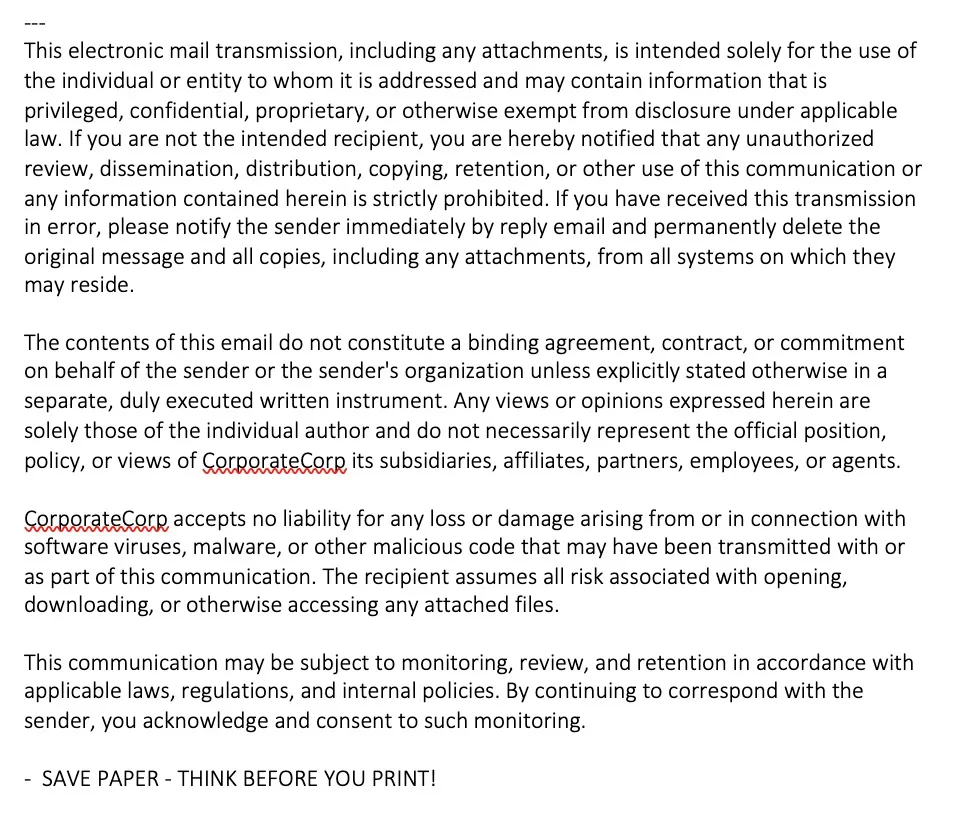
Here’s a typical email disclaimer. I’ve anonymised it. It’s basically identical to the ones I get dozens of times a week. I’m sure it’s the same for you:
The history of the email disclaimer
Here’s history: lawyers used to add a disclaimer cover sheet to written documents and faxes when sending legal documents. So in the late 90s, they started doing that for emails containing legal documents, too.
Also, in America in the early 2000s, the IRS revised something called ‘Circular 230’ to say that if tax advisers were giving informal advice by email, they should include a disclaimer pointing out ‘this is not formal advice’. 2 And because IT systems were clunky, it was easier to add these disclaimers onto all emails.
Clients received these, and like a sort of linguistic Cargo Cult, started making their own.
As far as I can tell 3, no email disclaimer has ever been used in a court case. And indeed the whole ‘you’re reading this email means you agree to what we just said’ just isn’t enforceable. (It’s not a contract unless both parties explicitly agree 4.)
What’s fascinating is that if we assume lawyers know perfectly well that email disclaimers are essentially useless, what we’re left with is entirely about tone.
What does an email disclaimer even mean?
Every single email disclaimer is essentially a bloviating 5 threat. Let’s break down what’s actually being said:
Did we send you this email by mistake? Oh, sh*t. That’s totally our bad. Please let us know. We’re not sure how threatening you and making it sound like a ton of extra work – run round deleting all traces of our mistake from your email servers! – will increase the likelihood of you giving us the heads up.
Whatever we’ve said here, it’s not binding, we didn’t mean it, and we don’t stand by it. Except obviously this email disclaimer. That’s carved in stone.
Barry from IT is totally reading your emails. There might well be valid reasons for this, but we’re not going to say what they are. We’re just gonna focus on telling you to suck it up because we said so.
Also, if you get a computer virus from us, that’s on you. We’re not sorry, we’re not concerned, we’re suddenly not even interested in you ‘notifying us’, even though that was a big deal for us just a moment ago and it would actually be super-helpful to know if we’d got a virus. But we’re in arse-covering mode now, so none of that matters.
Weird, innit.
Using your tone of voice in your email disclaimer
In all the tone of voice projects I’ve ever been involved with, only a few large corporations have ever begrudgingly agreed to simplify their disclaimers. Only one was up for a full overhaul. They agreed to this:
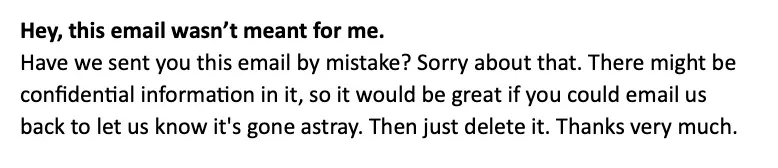
They were gonna give their legal and procurement teams a separate disclaimer. Everyone else, this. But then the legal team changed, the new ones got cold feet, and that was that.
It’s probably obvious where I’m going with this: if these witless, useless bits of nonsense are unkillable, then at least let’s make them:
a) Actually effective (you want me to notify you you’ve sent them an email by mistake? ASK NICELY OR I WON’T DO IT)
b) In your brand’s voice, not the voice of a pompous blowhard
c) Treat them as Easter eggs – opportunities to hide a little unexpected pleasure for anyone that strays down there.
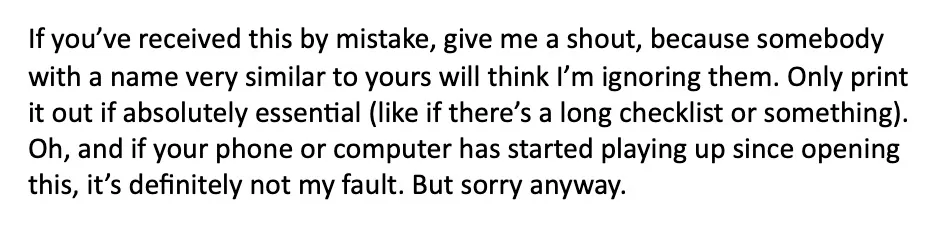
The best email disclaimer I’ve ever seen? It’s Dave ‘The Wordman’ Harland’s:
Want to shake up your brand’s email disclaimer? I’d love to help. Message me here.
DISCLAIMER
The contents of this Blog Article are not necessarily the opinions of the author, even the bits where he says ‘I think’ or ‘this is totally my opinion’. By reading this article, you acknowledge consent of Nick to repeatedly say the words ‘herein’, ‘hereby’, and ‘heretofore’. If you are not the intended recipient of this article – well, hello there! Nice to meet you.
1 Note to self: fact-check this.
2 In 2014, the IRS decided the tax disclaimer was unnecessary and said everyone could stop adding it, but by then, it was too late. The genie was out of the bottle.
3 Reference: Google, ChatGPT, Wikipedia, calling two actual lawyers.
4 ‘Silence does not indicate acceptance’ was established by Felthouse v Bindley (1862). It’s something to do with buying a horse off your nephew. I read it on LawTeacher.net. I notice the article itself has a disclaimer on saying it ‘does not constitute legal advice...’ 😖
If you’ve happened upon this blog from the depths of Google and are wondering what else I do. It’s this:
Buy the ‘ultimate approach to creating brilliant brand voices:
Voicebox - Everything you need to define and bring to life your brand's tone of voice. A complete method. In a box.
Read Tone Knob:
My Substack newsletter that unpacks what the world’s best brands do with their language.
Take my short course:
Say Hello to the 11 Primary Voices - A way of thinking about ‘the whole landscape of possibilities’ for brand voice