A better way to think about brand tone of voice. The 11 Primary voices are copywriting’s most powerful brain-tool.
Irony: as copywriters, we’ve not been great at explaining a brand’s ‘tone of voice’. Clients often get stuck, too: ‘It needs to be human yet professional’. Or ‘conversational – but not fluffy’. Not very helpful.
With many other things, we have useful mental models to help us: Consultants have their 2 x 2 grid. Brand folk love a Personality Archetype. Storytellers have the Hero’s Journey. .
Great mental models let you understand how things fit together. They help you focus on what matters. And they're a catalyst for fresh ideas.

“We’ve got frameworks and mental models to help us think better about just about everything – yet somehow copywriting got left behind. Not anymore.”
Chief Design Officer, Wolff Olins
The 11 Primary voices are a mental model for brand tone of voice.
The Straight-Talker. The Neutralizer. The Firestarter. The Impersonator... (OK, I won’t list them all). They’re a mental model that helps you understand, work with and create more distinctive brand tones of voice.
Now the 11 Primary voices have always been at the heart of Voicebox. Then people started telling me stories about how they were using them:
A professor in Denmark uses the 11 Primary Voices to teach a class on copywriting
An executive coach uses them to help clients find their personal speaking style
A brand agency has made the 11 Primary Voices their approach to ‘positioning’
And loads of writers dip into them for inspiration on all sorts of projects
Of course! The 11 Primary Voices are a mental model in their own right. You can use them for whatever you want.
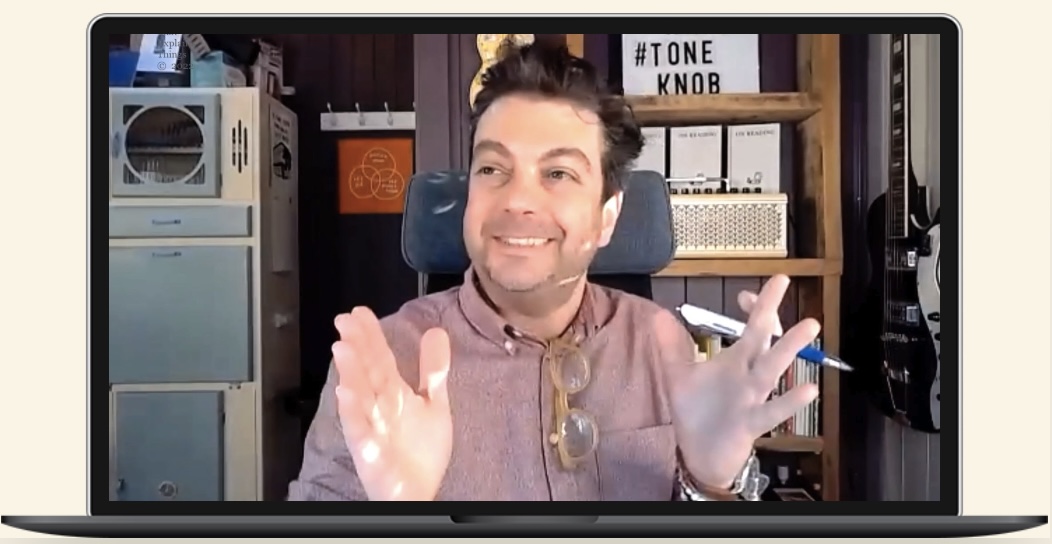
Add the 11 Primary Voices model to your brand voice mental toolkit.
That's why I’ve created this video to introduce the 11 Primary Voices.
It explains what the 11 Primary Voices are
There are real examples of tone of voice from great brands
It’s super-quick. Just 38 minutes long
How could YOU use the 11 Primary Voices mental model?
It’s not a course. There are no actionable takeaways. (Yes, I know that’s a terrible call to action). It’s a new tool for creative thinking. A new way of seeing the world. A new way to be inspired to do bolder, fresher, different-er creative work.
FAQs
Will the 11 Primary Voices help me define our brand’s tone of voice?
Yes, and no. The 11 Primary Voices give you a way of thinking about ‘the whole landscape of possibilities’ for brand voice. You will almost certainly find that this short course sets your mind whizzing with lots of ideas. But it’s not a complete approach to the process of finding the tone of voice that’s right for your brand. For that, you should definitely check out Voicebox. That’s a whole method for finding, creating, shaping and defining brand voices. It’s got lots more tools, exercises and games.
⁂
Can I try the 11 Primary Voices and then buy Voicebox?
Yes! In fact (and shhh, don’t tell anyone else), if you do go on to buy Voicebox, we’ll give you a handy discount code that takes off the price you already paid for the 11 Primary Voices. Think of this 38-minute video as a ‘try before you buy’ that unlocks some of the secrets behind creating a brand tone of voice using Voicebox.
⁂
Is the 11 Primary Voices just a video?
Yes. There’s nothing else to do, you just have to watch it 🙂
⁂
What’s the difference between a brand’s ‘content’ and ‘tone’?
There’s content (That’s what you say)
And there’s tone (that’s how you say it)
A brand’s ‘voice’ refers to how it expresses its personality through the words it chooses.
So, different brands will say the same thing in different ways.
· A formal brand might say ‘let’s commence’.
· An energetic brand might be more ‘let’s go, babyyyy!’
In reality, what we say and how we say it are inextricably woven together. It’s rarely just about ‘swapping one expression for another’.
Your brand’s content and tone is also linked to:
· how you see the world
· what you notice
· the kind of relationship you have with your customers
· and lots of other subtle and contextual things
⁂
Is a brand’s tone of voice about speaking, or writing, or what?
Good question. Given the word ‘voice’, you’d think it would be about speaking, wouldn’t you? And yet, mostly it refers to words that are written down. That could be words on packaging, or websites, or in stores, or on Apps. It might be on social media. It might be words that are written down as scripts or prompts, then used by people talking (for example, customer service people).
⁂
Should you have different brand tones of voice for different places?
This is one of those questions endlessly debated by copywriters, marketers and brand nerds. The simple answer is – mostly, no. Much better to have a strong, coherent, easily-recognisable tone of voice across everything, all the way down to your out of office replies. Creating a truly stand-out brand is hard work. Don’t confuse people or dilute your efforts by having different personalities in different contexts.
But! That’s not to say that your brand tone of voice should be rigidly the same all the time! Different channels have different strengths and different conventions. Different situations carry different expectations. You’ll always need to adapt with empathy.
(Think of your favourite band: they would play differently depending on if they were getting a stadium jumping, or if they were playing to soothe a baby to sleep. But they’d still have their ‘signature sound’ that you’d recognise in an instant.)
⁂
Are we talking about ‘tone of voice’, ‘brand voice’, ‘brand tone of voice’ or what?
You’ve noticed. Yes, this thing – a brand’s ‘voice’, has a few names. Originally, it was called ‘verbal identity’ (to make a nice pairing with ‘visual identity’). Over time, ‘tone of voice’ became the more usual term, particularly in the UK. ‘Brand voice’ is more usual in the US.
⁂
Just to complicate things. Brand Voice and Brand Tone?
There’s a bit of nuance – in the US, particularly in tech, people sometimes draw a distinction between ‘voice’ and ‘tone’. ‘Brand voice’ being the overall expression of your ‘personality’, and ‘brand tone’ being something that might flex depending on the particular situation. So, your overall ‘brand voice’ might be brash and irreverent, but you’d still modulate your tone if, say, you were apologising that your delivery truck accidentally ran over someone’s foot.
For practical reasons, I prefer to stick to either ‘tone of voice’ or ‘brand voice’. Partly because a) of course you should be modulating your tone depending on the situation you’re in or the person you’re talking to! b) when the time comes to, say, be more serious, only the specific context will actually tell you how your voice, in this situation, will modulate best.
If you’d like me to help you find your brand’s tone of voice? Hit me up.
⁂
Read Tone Knob:
My Substack newsletter that unpacks what the world’s best brands do with their language.
Take my short course:
Say Hello to the 11 Primary Voices - A way of thinking about ‘the whole landscape of possibilities’ for brand tone of voice
Buy the ‘ultimate approach to creating brilliant brand voices:
Voicebox - Everything you need to define and bring to life your brand's tone of voice. A complete method. In a box.
“This is brand and copywriting’s most profound, useful – and fun – mental model.”
Katherine Wildman, Founder, Haydn Grey